Profile
Tamyra Mensah-Stock, and the match that would not stay a footnote
Tokyo, 68 kilograms. An Olympic gold, and the first by a Black woman. The wrestling was pressure. The sentence is larger than the wrestling and also not a substitute for it.
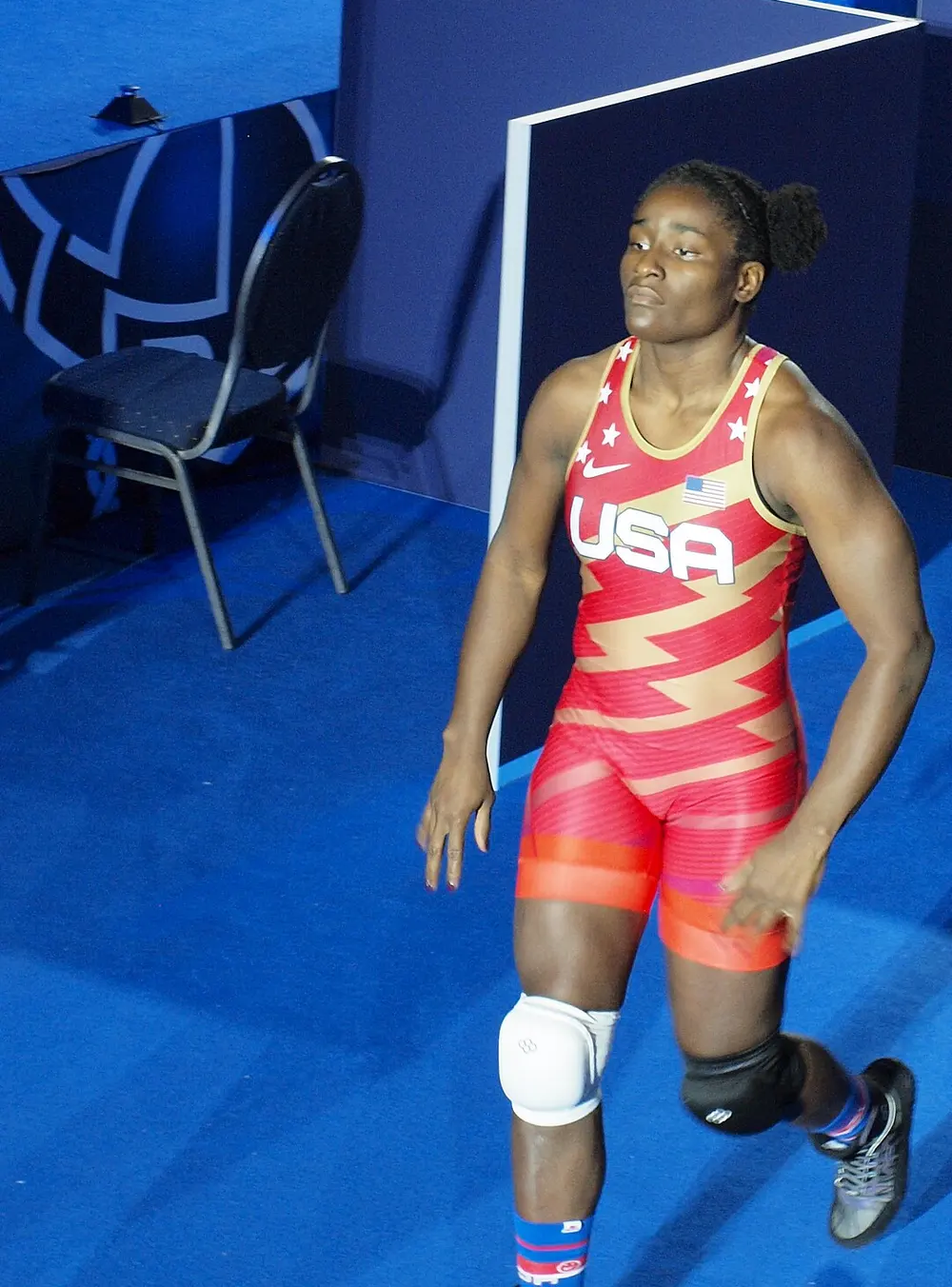
Tamyra Mensah-Stock won Olympic gold at women's 68 kilograms in Tokyo. She was the first Black woman to become an Olympic wrestling champion. Both halves of the sentence are the story. One is a result. The other is a fact about who had been missing from the photographs people use when they say Olympic champion.
On the mat she was not a symbol in a singlet. She was a heavy-handed, forward wrestler out of Texas, formed at Wayland Baptist, who made opponents carry her pressure for six minutes. She also won two world titles. The Olympic night is the one that travelled. The world titles are why the night was not a surprise to people who had been in the rooms.
Women's 68 kilograms has kept changing since. That is what a healthy weight does. Amit Elor won the Olympic gold at the same weight in Paris, younger than anyone the United States had put on that step. The division did not freeze in Tokyo. Mensah-Stock's gold remains a fixed point for this magazine whenever we write about it. Not a ceiling. A style. Pressure, if you can sustain it, is its own technique.
There is a temptation to write American women's wrestling as a single arc from Maroulis to Mensah-Stock to Elor. The arc is flattering and too straight. Different weights. Different bodies. Different coaches. What they share is that the podium stopped being hypothetical. The guide is the map of kilograms. The matches are where the map gets fingerprints on it.
Pressure is a technique. It just does not look like one in a still.
Joy, and the bout underneath it
The smile became the public fact, which is understandable and incomplete. She looked like a person who liked the thing she was excellent at. That is rare enough in a press conference to become the story. On the mat the story was heavier. She made people carry contact. If you rewatch Tokyo and you only watch her face after the whistle, you will miss the minute in which the other athlete stops trying to create space and starts trying to survive the tie.
Wayland Baptist is not a detail for the dateline. College wrestling in the United States is a specific education, and women's college wrestling was building itself in public during the years she was in it. The international translation still had to happen. Pressure that works in a dual does not automatically work when the other athlete has spent a decade in a national camp. Hers did. That is the craft sentence. The historic sentence can stand next to it without replacing it.
Two world titles are the reason people who actually follow the sport were not stunned in Tokyo. They might have been moved. Those are different reactions, and magazines owe readers the difference. Astonishment is what you feel when you have not been paying attention. Recognition is what you feel when the podium matches the rooms.